
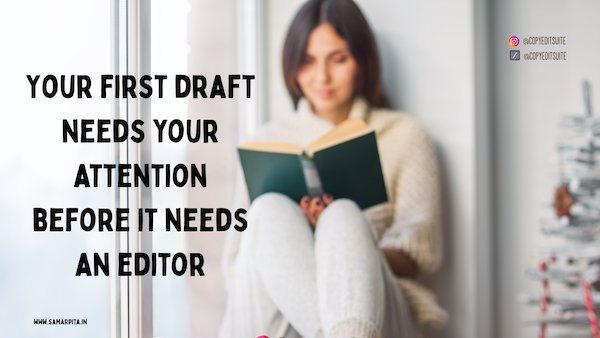
Finishing a first draft is a huge deal. It means you showed up, wrote through doubts, and stayed with your story till the end. That alone deserves celebration.
But it doesn’t mean your manuscript is ready for an editor.
And sending it in too early? That’s where most authors go wrong.
I get it—you’ve spent months (maybe years) on this book. You want it to move forward. The idea of handing it off to a professional feels like the next step. But hitting “send” right after you finish your first draft is like baking a cake and delivering it to a party half-done. It might smell good, but no one’s ready to eat it.
Also Read: Most stories break because the plot has holes no one noticed
Why your first draft isn’t ready yet
A first draft is a raw, unfiltered version of your story. It’s where you figure things out—who your characters are, how the plot moves, what your voice sounds like.
Your first draft is not supposed to be clean. It is supposed to be messy.
Most first drafts have:
-
Inconsistent character behaviour
-
Loose or missing subplots
-
Wandering dialogue
-
Repetitive phrasing
-
Gaps in logic or world-building
-
Pacing problems
-
Unfinished ideas
That’s normal. What’s not normal is expecting an editor to fix all of that in one round. It’s also expensive—and inefficient.
What editors are (and aren’t) for
Editors help shape your book, not write it for you. They guide, refine, and elevate your work—but they don’t replace the deep revision that only you can do.
Example:
If your protagonist suddenly disappears from two chapters with no explanation, a good editor will flag it. But it’s up to you to rewrite, restructure, or rethink that section. If your manuscript has dozens of these, the edit becomes a rescue mission.
Also Read: How to Develop Compelling Characters: A Guide for New Writer
That’s not what you want. You want an edit that brings clarity, not chaos.
What you should do before hiring an editor
Here’s what your manuscript needs first:
1. A full read-through
Step away for at least two weeks after finishing your draft. Then read it start to finish like a reader. Take notes. You’ll spot what’s missing or off.
2. A messy revision
Don’t polish yet. Rework the big things—plot holes, character arcs, timeline issues, unresolved threads. Cut scenes that go nowhere. Add what’s needed to make the story feel whole.
3. A line-level pass
Now clean it. Fix clunky sentences, awkward phrasing, and wordy bits. Replace generic words with stronger ones. Check transitions and chapter breaks.
4. A spellcheck—but don’t stop there
Run your manuscript through a grammar tool like Grammarly, Hemingway, or ProWritingAid. Don’t treat this as editing. It just cleans surface clutter.
5. A feedback round
Give your draft to one or two trusted beta readers or critique partners. Ask clear questions. What confused them? Where did they lose interest? What felt strong?
You’ll gain insight into what works—and what still doesn’t.
Also Read: Crafting Captivating Openings: A Guide to Grabbing Readers’ Attention
Offbeat tip: Read your manuscript aloud
Yes, the whole thing. Hearing your words will show you the rhythm of your sentences, the emotion behind your dialogue, and where things drag. Many writers skip this step. Those who don’t often find their biggest breakthroughs here.
But I want to move fast—can’t the editor just handle it?
Here’s the truth: the better shape your manuscript is in, the more value you get from your editor.
If you send in a raw draft, I’ll spend time flagging what you already know is broken. If you revise first, I get to focus on things you can’t see—structure flaws, voice inconsistencies, pacing layers, deeper clarity.
You’ll save money, avoid frustration, and walk away with a much stronger book.
Final thoughts
You don’t need a perfect draft. No one expects that. But you do need a draft that shows you’ve done the hard work first.
A good editor will meet you where you are—but the closer you get to the best version of your manuscript, the more impact we can create together.
Ready for an expert eye on your polished draft?
If you’ve done the heavy lifting and now need someone to sharpen your story, I’m here to help. I work closely with authors to elevate their manuscripts without compromising their voice.
📩 Reach out now to book your edit and take your story to the next stage—with intention and impact.
📩 Email me at editor@samarpita.in to discuss how we can grow your brand with strategy-led content.
📱 Let’s connect on social:
Follow me on Instagram and X (formerly Twitter) for tips, insights, and behind-the-scenes content ideas.